
When people think of iconic American road trips, Buc-ee’s is never far from the conversation. Those massive, spotlessly clean travel centers with their cheerful beaver mascot have become a cultural landmark across the South. But behind the brand stands one quietly determined man: Arch “Beaver” Aplin III.
His story is not about overnight success or venture capital. It is a decades-long journey built on discipline, customer obsession, and a vision that redefined what a convenience store could be. Today, Arch Aplin III’s net worth is estimated between $1 billion and $1.5 billion, and every dollar tells a story.
Arch Aplin III Net Worth Overview
| Detail | Information |
| Estimated Net Worth | $1 billion – $1.5 billion (2026) |
| Primary Wealth Source | Buc-ee’s ownership stake |
| Secondary Sources | Real estate, branded merchandise |
| Company Status | Privately held (not publicly traded) |
| Net Worth Trend | Steadily growing with each new store opening |
As of 2026, Arch Aplin III’s net worth is broadly estimated between $1 billion and $1.5 billion. Because Buc-ee’s has never gone public and does not release financial disclosures, every figure in circulation is an informed estimate rather than a verified number. What analysts agree on is the trajectory: his wealth has grown consistently alongside the brand’s national expansion, making him one of the wealthiest entrepreneurs in the Texas retail landscape.
Who Is Arch Aplin III?
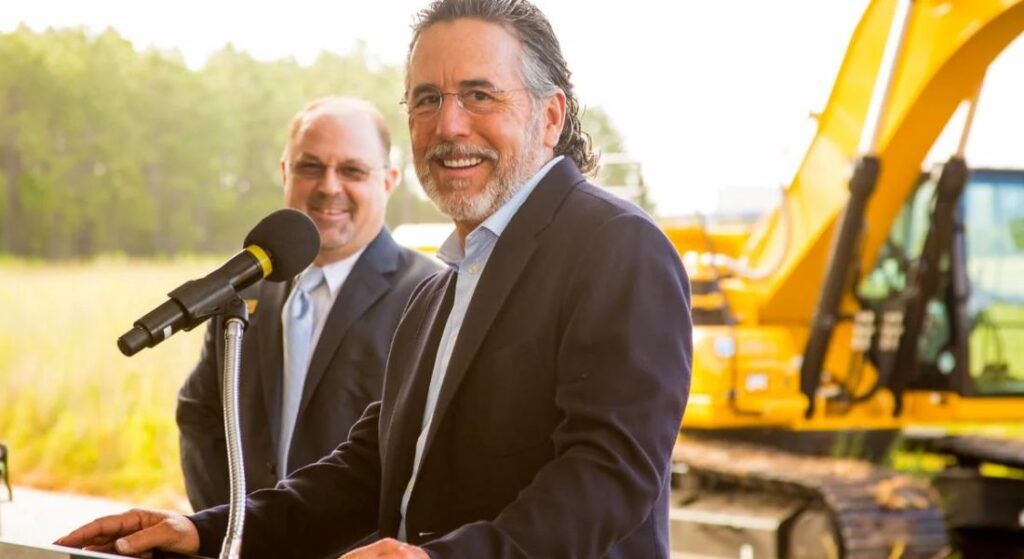
Arch Aplin III, widely known by his nickname “Beaver,” is an American entrepreneur, CEO, and co-founder of Buc-ee’s, the Texas-born chain of mega travel centers that has transformed highway retail across the United States. Unlike most billionaires who court the spotlight, Aplin has built his empire from behind the scenes, letting the Buc-ee’s brand speak for itself.
He is recognized not only for his business acumen but also for his commitment to public service and philanthropy. From serving as Chairman of the Texas Parks and Wildlife Commission to donating tens of millions to Texas A&M University, Aplin represents a rare type of wealth builder: one who reinvests in both his business and his community.
Read More: Who Is Klarissa Munz? Everything to Know About Freddie Highmore’s Wife
Early Life and Education
Birthplace and Childhood
Arch Aplin III was born on June 13, 1958, in Lake Jackson, Texas. He grew up in a household shaped by entrepreneurship, his father, Arch “Charley” Aplin Jr., was involved in small business ventures, and the family culture emphasized hard work, ingenuity, and customer relationships. From a young age, Aplin was exposed to the inner workings of commerce, whether through family-run auto parts businesses or local trade.
His grandfather’s general store experience reportedly served as an early inspiration, giving young Arch a tangible picture of what it meant to serve a community through retail.
Academic Background
Aplin attended Texas A&M University, graduating in 1980 with a Bachelor of Science in Construction Science. This degree would prove unusually valuable. When you are designing and building travel centers that regularly exceed 50,000 square feet, understanding structural design, project management, and construction logistics gives you a decisive operational edge. His academic background directly shaped how Buc-ee’s stores were planned, built, and scaled.
The Founding of Buc-ee’s
In 1982, Arch Aplin III and his business partner Don Wasek co-founded Buc-ee’s, opening their first store in Lake Jackson, Texas. Their founding philosophy was straightforward but ambitious: create a roadside stop that customers could genuinely trust, clean, well-stocked, and welcoming.
What Made the First Store Different
From day one, Buc-ee’s separated itself from the competition through a few non-negotiable standards:
- Immaculate restrooms, Buc-ee’s bathrooms became legendary, earning national media coverage and word-of-mouth loyalty that no advertising budget could replicate.
- Extensive product variety, Far beyond fuel and snacks, early stores offered fresh food, Texas-made goods, and a wide range of merchandise.
- Exceptional customer service, Every detail of the in-store experience was designed with the traveler’s comfort in mind.
The beaver mascot, inspired by Aplin’s own nickname, became one of the most recognizable brand symbols in American retail. That simple mascot decision turned Buc-ee’s into a destination, not just a stop.
Business Growth and Wealth Building
The No-Franchise, No-IPO Strategy
Perhaps the most important wealth-building decision Aplin ever made was what he chose not to do. He never franchised Buc-ee’s. He never took the company public. By maintaining full private ownership and reinvesting profits directly into expansion, every new store opened increased his personal asset value rather than diluting it through shareholders.
This long-term thinking is the core of Arch Aplin III’s financial story.
Expansion Across the United States
Buc-ee’s grew from a regional Texas phenomenon into a national brand. By 2026, the company operates over 50 locations across Texas, Florida, Alabama, Georgia, Tennessee, and other Southern states. Each new location is strategically placed along high-traffic interstate corridors, ensuring maximum footfall and revenue generation.
The mega-store format, with some locations spanning over 74,000 square feet, generates far higher revenue per location than any traditional convenience store. Annual revenues are reported to exceed $750 million, a figure that continues to climb with each new opening.
Key Wealth Drivers
- Buc-ee’s ownership stake: The primary and dominant source of his estimated $1–$1.5 billion net worth
- Real estate holdings: Travel center land and property connected to each location represents significant long-term asset value
- Branded merchandise: Buc-ee’s branded apparel, food products, and novelty items generate an estimated $100 million annually
- Fuel sales: High-volume fuel stations at each location contribute steady, recurring revenue
Income Sources Beyond Buc-ee’s

While Buc-ee’s accounts for the vast majority of Arch Aplin III’s wealth, his financial portfolio extends beyond the brand itself.
His construction science background informed early real estate decisions, and property assets tied to travel center development across multiple states have appreciated significantly over time. Reports also suggest investments in infrastructure and community development projects in Texas, consistent with his long-term approach to capital allocation.
His public service role as Chairman of the Texas Parks and Wildlife Commission, though not a financial venture, reflects the type of network-building and civic influence that often supports long-term business relationships and brand goodwill.
Lifestyle and Personal Interests
Arch Aplin III lives a notably private life for someone of his wealth. He is not a fixture on the celebrity circuit, does not maintain public social media accounts, and rarely grants media interviews. His lifestyle reflects the same operational philosophy he applies to his business: quiet, deliberate, and focused on outcomes rather than optics.
Known interests and lifestyle details include:
- A lakehouse on Lake Conroe, Texas, consistent with the outdoor lifestyle of many prominent Texans
- Strong affiliation with Texas A&M, including attendance at Aggies games
- A deep love of the Texas outdoors, evidenced by his work with the Texas Parks and Wildlife Commission
- An appreciation for community events, including serving as Grand Marshal for the Downtown Rodeo Parade in Houston
Family Life and Relationships
Arch Aplin III is married to Joanie Aplin. The couple has five children together. Like most aspects of Aplin’s personal life, details about his family are kept deliberately private. His family-oriented values have reportedly shaped Buc-ee’s workplace culture, which is known for paying above-average wages and offering strong employee benefits by industry standards.
His father is Arch “Charley” Aplin Jr. and his mother is Lorita DelaCroix Aplin. The family’s entrepreneurial roots run deep, and those early lessons about business and community shaped the man who would eventually build one of America’s most beloved retail brands.
Age, Height, and Physical Appearance
| Detail | Information |
| Full Name | Arch “Beaver” Aplin III |
| Date of Birth | June 13, 1958 |
| Age (2026) | 67 years old |
| Birthplace | Lake Jackson, Texas, USA |
| Nationality | American |
| Height | Approximately 5’10” (estimated) |
| Education | B.S. Construction Science, Texas A&M University (1980) |
Philanthropy and Community Impact
Arch Aplin III’s contributions extend well beyond his business. He is a recognized philanthropist with a clear focus on education and environmental stewardship.
Major Philanthropic Contributions
- Texas A&M University: Aplin donated $60 million to establish the Aplin Center, one of the most significant private donations in the university’s history, reflecting his deep ties to his alma mater.
- Wildlife and conservation: His tenure as Chairman of the Texas Parks and Wildlife Commission placed conservation policy at the forefront of his public service work.
- Local community initiatives: Buc-ee’s expansion into new regions is often accompanied by job creation and local economic investment, with each new store typically employing hundreds of local workers at competitive wages.
His approach to giving mirrors his approach to business: long-term, purposeful, and community-driven.
Social Media and Public Presence
Arch Aplin III maintains virtually no personal social media presence. He does not operate verified accounts on Instagram, X (formerly Twitter), or Facebook. Most public updates about him emerge through Buc-ee’s official announcements, local Texas media, and business publications.
This intentional privacy stands in sharp contrast to the enormous brand visibility of Buc-ee’s itself, which has a strong social media following and a highly engaged customer community. Aplin has effectively built a billion-dollar brand identity around a cartoon beaver rather than his own persona, a strategy that has proven remarkably durable.
Fun Facts and Lesser-Known Details
- The Buc-ee’s beaver mascot was directly inspired by Aplin’s lifelong nickname, “Beaver.”
- Buc-ee’s has won multiple “Best Restroom in America” awards, a marketing triumph that cost nothing to earn.
- The chain’s Beaver Nuggets (caramel-coated corn puffs) have become a cult snack with national shipping demand.
- Aplin studied construction science, not business, yet built one of the most operationally efficient retail chains in the country.
- Buc-ee’s was an induction into the Texas Business Hall of Fame in 2024, a recognition of the brand’s cultural and economic impact.
- The company’s largest locations have more square footage than some regional shopping malls.
- Buc-ee’s has begun installing EV charging stations, positioning the brand for the next generation of road travelers.
FAQ’s
What is Arch Aplin III’s net worth in 2026?
His net worth is estimated between $1 billion and $1.5 billion, primarily from his ownership stake in Buc-ee’s and related real estate holdings.
How did Arch Aplin III make his money?
He built his wealth through decades of private ownership of Buc-ee’s, reinvesting profits rather than selling equity or franchising, while also accumulating real estate assets connected to each travel center.
Who co-founded Buc-ee’s with Arch Aplin III?
Arch Aplin III co-founded Buc-ee’s with his business partner Don Wasek in 1982.
Is Buc-ee’s publicly traded?
No. Buc-ee’s is a privately held company and has never conducted an IPO, which is a key reason why exact financial figures are unavailable.
How many children does Arch Aplin III have?
He and his wife Joanie Aplin have five children together.
Where did Arch Aplin III go to college?
He graduated from Texas A&M University in 1980 with a degree in Construction Science.
What is the Aplin Center at Texas A&M?
It is an academic and research center funded by Aplin’s $60 million donation to Texas A&M, reflecting his commitment to education and his alma mater.
How many Buc-ee’s locations exist in 2026?
Buc-ee’s operates over 50 locations across multiple states, including Texas, Florida, Alabama, Georgia, and Tennessee.
Conclusion
Arch Aplin III’s story is one of the most quietly remarkable wealth-building narratives in modern American business. He did not disrupt technology. He did not chase venture capital. He simply took an industry everyone had written off as unremarkable, the roadside convenience store, and refused to accept its limitations.
By prioritizing cleanliness, customer experience, and long-term private ownership over short-term gain, he transformed a single Lake Jackson gas station into a multi-billion-dollar brand with a cult following that spans the nation. His estimated net worth of $1 billion to $1.5 billion in 2026 is the financial result of over four decades of disciplined reinvestment and operational excellence.
Beyond the numbers, Arch Aplin III represents something increasingly rare: a business leader whose wealth creation and community values are genuinely aligned. Through education philanthropy, conservation work, and a company culture that treats employees well, he has built a legacy that will outlast any single store opening or revenue milestone.

Leave a Reply